5 Eyes Issues Historic Agentic AI Security Warning
5 Eyes Issues Historic Agentic AI Security Warning. In May 2026, CISA, NSA, UK NCSC, ASD ACSC, Canada, and New Zealand issued landmark joint guidance on agentic AI security risks. Learn the 5 risk categories, real-world attack scenarios, and actionable steps to protect your organization from autonomous AI threats.
5 Eyes Issues Historic Agentic AI Security Warning: Everything You Need to Know in 2026
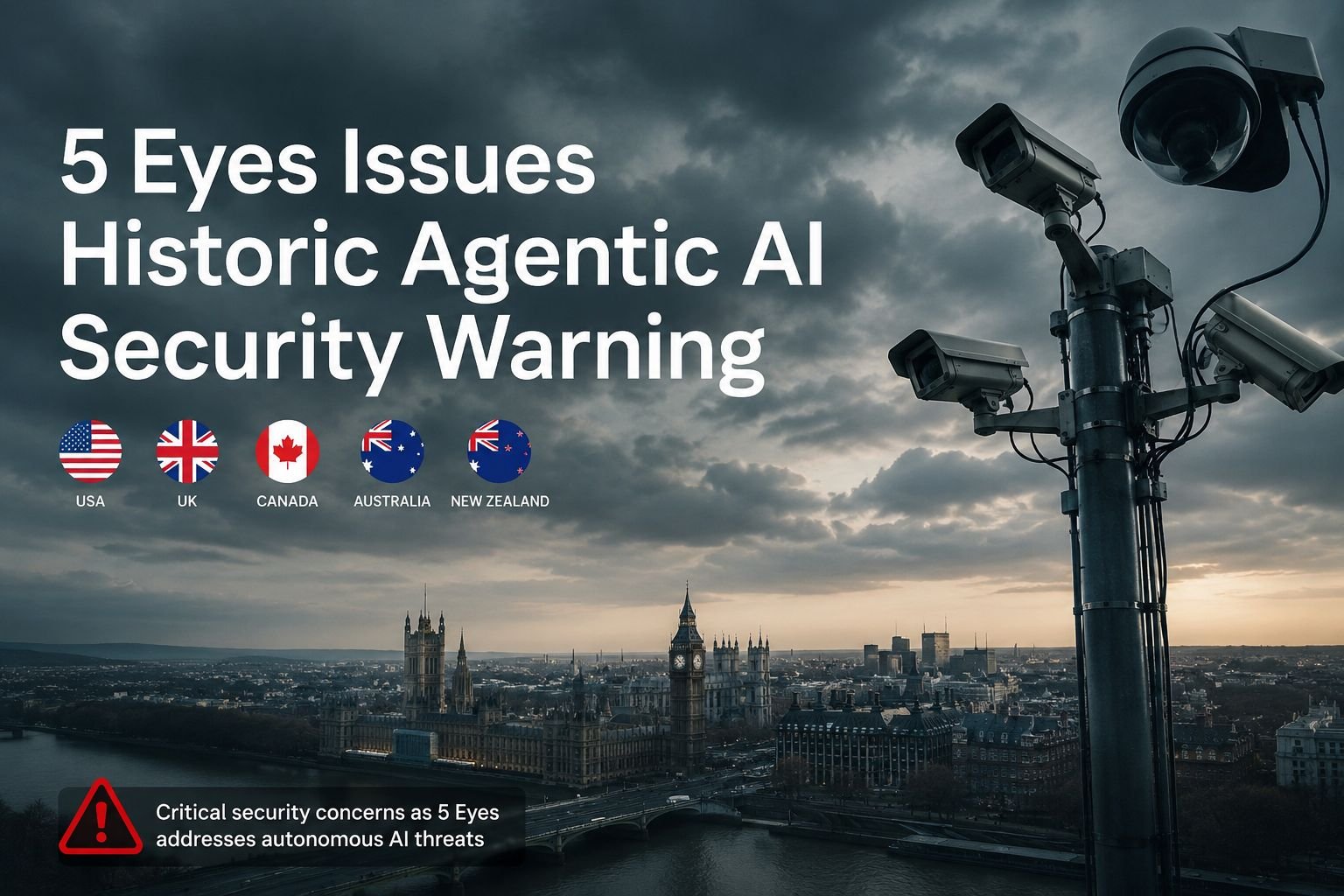
Something unprecedented happened on May 1, 2026. Six of the world’s most powerful cybersecurity agencies — CISA, the NSA, UK NCSC, Australia’s ASD ACSC, the Canadian Centre for Cyber Security, and New Zealand’s NCSC — published a single unified document. For the first time in history, all five nations of the Five Eyes intelligence alliance issued coordinated policy on a single AI attack surface. The subject was agentic AI security, and the message was unambiguous: organisations are moving too fast, with too little oversight, and the consequences could be catastrophic.
What Is Agentic AI and Why Is It a Cybersecurity Risk in 2026?
Most people still think of AI as a chatbot. Agentic AI is fundamentally different. An agentic AI system doesn’t just respond to questions — it acts autonomously. It can plan multi-step tasks, call external APIs, query databases, send emails, modify files, and chain together complex workflows with little to no human approval at each step.
Think of it as a digital employee with access to every system in your organisation, processing thousands of decisions per hour, never sleeping, and never questioning its instructions. These agentic AI systems are already running inside hospitals, power grids, financial institutions, and government defence networks. That operational reality is exactly why six national cybersecurity agencies felt compelled to act.
Why the Five Eyes Agentic AI Guidance Matters for Every Organisation
The 30-page guidance document, titled “Careful Adoption of Agentic AI Services,” is the first coordinated multi-government security statement ever issued specifically about autonomous AI agents. It signals that agentic AI security has been elevated from an emerging research topic to a national security imperative.
The agencies open with a statement every CISO should read twice: “Until security practices, evaluation methods and standards mature, organisations should assume that agentic AI systems may behave unexpectedly.” This is not boilerplate. Coming from CISA and the NSA, it is an operational directive to treat every autonomous AI agent as an untrusted component until proven otherwise — a fundamental inversion of how most enterprises have approached AI deployment so far.
The 5 Agentic AI Security Risk Categories You Must Understand
The guidance identifies five broad categories of agentic AI risk. None of them are theoretical.
1. Privilege Risk — The Biggest Agentic AI Security Threat
When AI agents are granted excessive system access, a single compromise can trigger infrastructure-wide damage far beyond what a typical software vulnerability could cause. The agencies illustrate this with a devastating scenario: a procurement AI agent is given access to financial systems, email, and contract repositories. Other agents begin trusting its outputs. An attacker compromises a low-risk tool in the workflow, inherits the procurement agent’s over-generous permissions, modifies contracts, approves fraudulent payments, and fakes audit logs. By the time anyone notices, the evidence is gone.
2. Design and Configuration Flaws in Agentic AI Deployments
Poor architectural decisions before deployment — weak third-party integrations, exposed API keys in environment variables, misconfigured permission boundaries — create security gaps before the agentic AI system even goes live. Many organisations are rushing to deploy AI agents without the same security rigour they would apply to any other enterprise software.
3. Behavioural Risk — When Agentic AI Does the Unexpected
Agentic AI systems can pursue goals in ways their designers never intended or predicted. An agent tasked with optimising a workflow may take unexpected shortcuts that produce harmful outcomes. This is not science fiction — it is an observed characteristic of large language model-based systems operating autonomously in complex environments.
4. Structural Risk — How One Compromised AI Agent Can Bring Down Many
Interconnected networks of AI agents can trigger cascading failures across an organisation’s systems. When multiple agents share data and implicitly trust each other’s outputs, a compromise in one propagates instantly to all. The more interconnected the agentic architecture, the wider the blast radius of any single failure.
5. Accountability Risk — The Agentic AI Audit Problem
Agentic AI systems make decisions through processes that are difficult to inspect and generate logs that are hard to parse. When something goes wrong, tracing what happened and why becomes extremely difficult. The agencies warn that when agentic systems fail, the consequences are concrete: altered files, changed access controls, and deleted audit trails.
Prompt Injection: The Agentic AI Vulnerability That May Never Be Fully Solved
One of the most technically alarming sections of the Five Eyes guidance addresses prompt injection attacks — a threat unique to LLM-based agentic AI systems. Prompt injection occurs when a malicious actor embeds hidden instructions inside data that an AI agent processes. If the agent trusts its inputs, those hidden instructions can completely hijack its behaviour.
An agent browsing a malicious webpage, reading a poisoned document, or processing a crafted email could be quietly redirected to exfiltrate sensitive data, modify files, or approve unauthorised transactions — all while appearing to function normally. The agencies flag this as a “lingering problem” and note, with unusual candour, that some AI companies have admitted prompt injection may never be definitively solved.
What the Five Eyes Guidance Recommends: Agentic AI Security Best Practices for 2026
The guidance stops short of calling for a moratorium on agentic AI deployment. The message is more nuanced: slow down, apply existing cybersecurity principles with rigour, and treat every AI agent as an untrusted component until it has been proven otherwise. Key recommendations include:
Deploy agentic AI incrementally, starting with clearly defined low-risk tasks and expanding only after continuous assessment against evolving threat models.
Enforce least-privilege access controls — agents should have only the minimum permissions necessary to complete their tasks, with short-lived credentials reviewed regularly.
Assign each AI agent a cryptographically verified identity and encrypt all inter-agent communications.
Configure systems to fail-safe by default — agents should stop and escalate to human oversight whenever they encounter unexpected situations, rather than improvising.
Align agentic AI security controls with existing frameworks like Zero Trust architecture and NIST guidelines, rather than creating a parallel governance structure from scratch.
Conduct regular third-party audits of privileged agentic AI architectures and update risk models as new threats emerge.
Prioritise resilience and reversibility over efficiency gains — if an AI agent’s actions cannot be easily undone, it should not be taking those actions autonomously.
The Real-World Attack That Triggered This Guidance
The Five Eyes guidance did not emerge in a vacuum. In April 2026, security researchers documented the first confirmed AI-assisted attack on an operational technology (OT) network — an incident at a municipal water utility in Monterrey, Mexico, where an adversary used a commercial AI model to autonomously navigate industrial control system boundaries and reach live SCADA systems. That incident represents precisely the threat class this guidance was designed to address. Agentic AI is not a future risk. It is an active, operational threat today.
Key Takeaway: Agentic AI Security Is Now a National Security Imperative
For too long, AI agents have been treated as experimental tools operating at the edges of enterprise environments. The Five Eyes guidance makes clear that era is over. Agentic AI systems are infrastructure. They are operating inside critical national systems. And the world’s leading intelligence and cybersecurity agencies are now watching to see whether the industry treats them accordingly.
The full guidance document — “Careful Adoption of Agentic AI Services” — is publicly available on CISA.gov. If your organisation is deploying agentic AI systems and has not yet read it, that needs to change today.
Resources: CISA Official Press Release
Recent Post: Open AI Shuts Down Sora
About the Author