Best AI Tools for Teachers in 2026
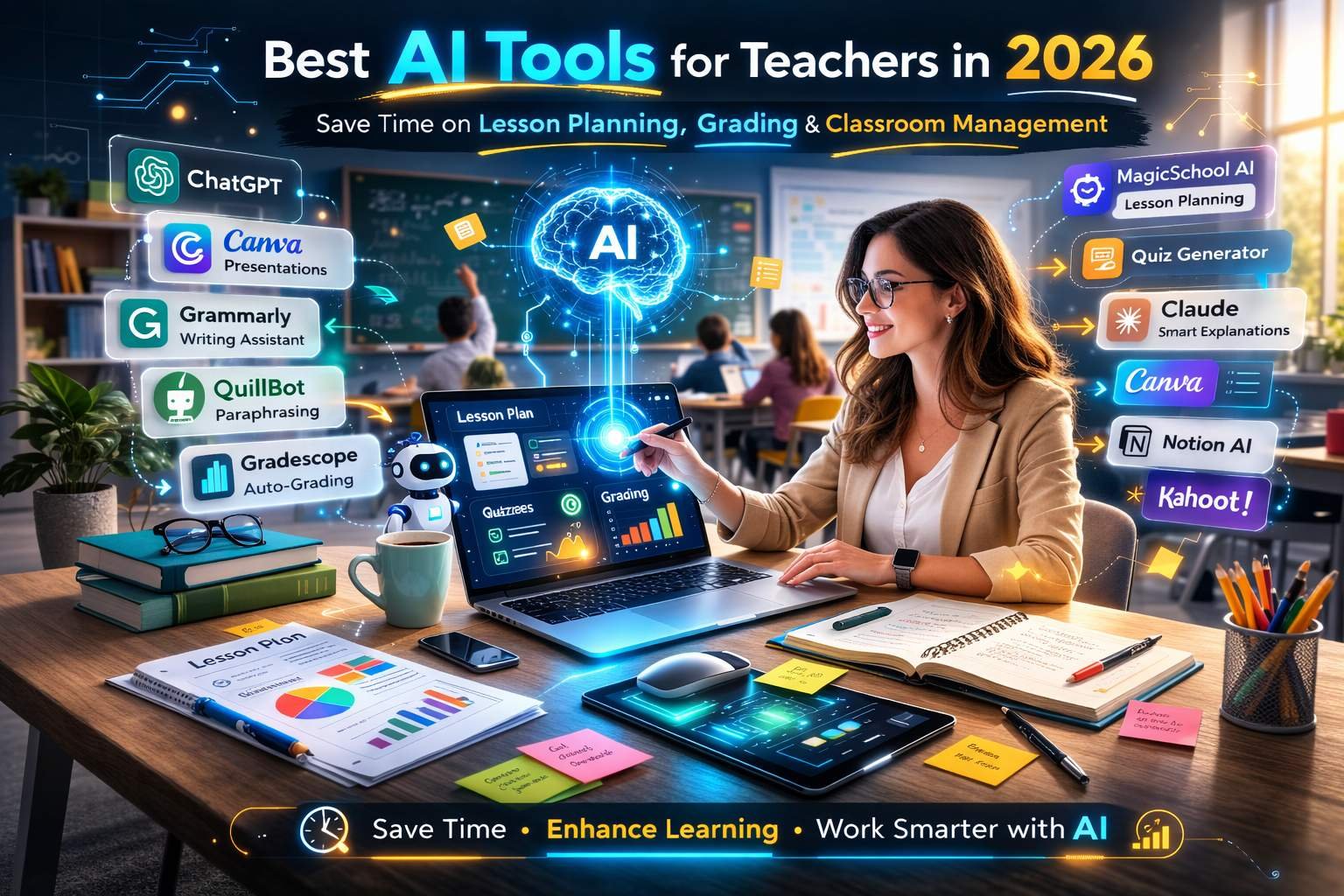
Being a teacher in 2026 is more than ever before. Are you still exploring Best AI Tools for Teachers in 2026? The teachers are supposed to teach using interesting lessons, customizing education, administering evaluations, and administrative tasks besides time to do personal growth. This is where educator AI-assistants are becoming a necessity, not a replacement, but a strong ally that will save time and burnout.
In this guide, we are going to discuss the most useful AI tools among the teachers in 2026, based on the real classroom applications, such as lesson planning, grading, quizzes creation, presentations, writing support, and productivity. Regardless of the teaching platform: K-12, higher education or online learning, these tools may assist you to work smarter, but not longer.
Why Teachers are Going to use AI tools in 2026
The use of AI in education has increased at an accelerated rate, because of three main factors:
Saving of time – Teachers will save time of many hours per week performing repetitive tasks.
Individualized learning – AI assists in adjusting the content to the levels of students.
Better interaction – Interactive and visuality increases student interest.
Utilized in a responsible manner, AI tools can improve the quality of teaching and enable the educator to concentrate on what is really important: students.
Best AI Tools for Teachers in 2026
| AI Tool | Best For | Free Version | Ideal Use Case |
|---|---|---|---|
| ChatGPT | Lesson planning, explanations | Yes | Daily teaching assistant |
| Claude | Student-friendly content | Yes | Clear explanations |
| Canva | Presentations & visuals | Yes | Classroom slides |
| Grammarly | Writing & feedback | Yes | Emails & reports |
| QuillBot | Paraphrasing | Yes | Simplifying content |
| Gradescope | Grading automation | Limited | Exam & assignment grading |
| MagicSchool AI | Education workflows | Yes | Teacher-specific tasks |
1: ChatGPT – Best AI Tools for Teachers in 2026
ChatGPT will be among the most applicable AI tools to teachers in 2026. It serves as a 24 hours teaching assistant that can assist anyone with almost all the classroom activities.
Ideal use cases:
- Development of lesson plans that conformed to the requirements of the curriculum.
- Producing simpler explanations of complicated issues.
- Creating quizzes and worksheets and discussion prompts.
Writing parent email and reports.
Pros
- Extremely flexible
- Saves hours every week
- Works across all subjects
Cons
- Student needs teacher inspection to be accurate.
- Best results are achieved by clear needs prompting.
Best: This is best suited to teachers who would like to have one tool that can perform nearly everything.
2: Claude – Best at Expositor Higher Results.
Claude, especially, is a good writer of clear, well-constructed and student friendly explanations. It is more popular with teachers as educational material due to its relaxing tone and clarity.
Ideal use cases:
- Decomposition of hard concepts.
- Creating reading materials
- Funding of humanities and social sciences.
Pros
- Natural explanations, which can be read.
- Less hazardous deliverables in the classroom.
Cons
- Less integration than other competitors.
Best in: Teachers that emphasize reading-intensive and comprehension subjects.
3: Canva – The Best Ai Tool for Presentations.
The visual learning is paramount, and Canva is still leading in this field. It has an AI-based functionality that enables teachers to make professional-like presentations, worksheets, posters, and infographics within minutes.
Why teachers love Canva:
- AI generation of slides using text.
- Millions of education templates.
- Easy drag-and-drop editor.
Pros
- No design skills required.
- Very good in learning with the student.
Cons
- There are some premium resources which demand a paid plan.
- Best: The lessons will be appealing to teachers who desire some visuals.
4: Grammatically – Best to write and receive feedback.
Effective communication is critical in the teaching profession and Grammarly is there to assist teachers in drafting refined emails, responses, reports and lesson plans.
Uses in education:
- Correcting grammar and tone
- Enhancing clear instructions.
- Giving students an improved written feedback.
Pros
- Easy to use.
- Plays in Web browsers and applications.
Cons
- Premium is required to come up with advanced suggestions.
Best: Teachers who write a lot and want to communicate on the professional level.
5: QuillBot – The most effective AI to simplify the content.
QuillBot is suitable when it comes to rewriting and simplifying the content. Teachers frequently go through it to differentiate material according to the grade or language levels.
Common uses:
- Simplifying textbooks.
- Production of various pieces of content.
- Use of non-repetitive words.
Pros
- High quality of the paraphrasing.
- Useful free version.
Cons
- A non-complete lesson-planning tool.
- Best: Differentiated instruction.
6: Gradescope – The Best AI Grader.
One of the most time consuming areas of education is grading. Gradescope relies on AI-enhanced processes with the aim of accelerating the grading process and enhancing its consistency.
Best for:
- Large classes.
- Quizzes and high stakes tests.
- Rubric-based grading.
Pros
- Significant time savings.
- Fair and consistent grading.
Cons
- Learning curve for new users
Best when: Teachers have heavy loads of assessment-based assessments in university and high-school.
7: MagicSchool AI – Best AI Built Specifically for Teachers
MagicSchool AI is solely teacher-focused and provides lesson planning tools, IEP writing, rubrics and classroom management tools.
Why it stands out:
- Education-specific workflows.
- Safe and compliant design.
- Built with teachers in mind.
Pros
- Purpose-built for schools.
- Easy to use.
Cons
- Within smaller ecosystem in comparison with general AI tools.
Best in: Teachers seeking a single platform of education AI.
Comparison of Free and paid AI tools to use in teaching.
Whether free AI tools are sufficient is the question of many teachers. The solution is work based.
Free tools are enough if you:
- Teach smaller classes.
- Use AI occasionally.
- Need basic support.
Paid tools are worth it if you:
- Manage multiple classes.
- Want advanced automation.
- Demand dependability and incorporations.
Most of the teachers in this case begin with the free plans and upgrade after they realise actual time savings.
Are Artificial Intelligence Tools secure and permitted in schools?
By the year 2026, the majority of schools permit the use of AI tools in a responsible manner. Best practices include:
- Never post confidential student information.
- AI should be a support tool but not an easy way out.
- Adhere to school and district policy.
With the right application, AI does not substitute good teaching; on the contrary, it makes it better.
Final Conclusion: Best AI Tools for Teachers in 2026
- Best overall AI tool: ChatGPT
- Better than explanations: Claude.
- Best for visuals: Canva
- Best for writing: Grammarly
- Best for grading: Gradescope
- Best teacher-specific platform MagicSchool AI.
Artificial intelligence is no longer a luxury, but it is turning out to be a necessity in the classroom. Those teachers who learn to use them efficiently will save time, be less stressed, and make learning experiences more favorable.
While we are on the topic of cutting-edge technology, if you are into AI tools, do not miss our latest posts on Google Veo 3.1, OpenAI Sora, and our in-depth Veo 3.1 vs Sora comparison — the future of content creation is moving fast.
About the Author